The Cost of Waiting: How Trial Delays Erode Radiopharma Asset Value
The Cost of Waiting: How Trial Delays Erode Radiopharma Asset Value
In radiopharma, time is valuation.
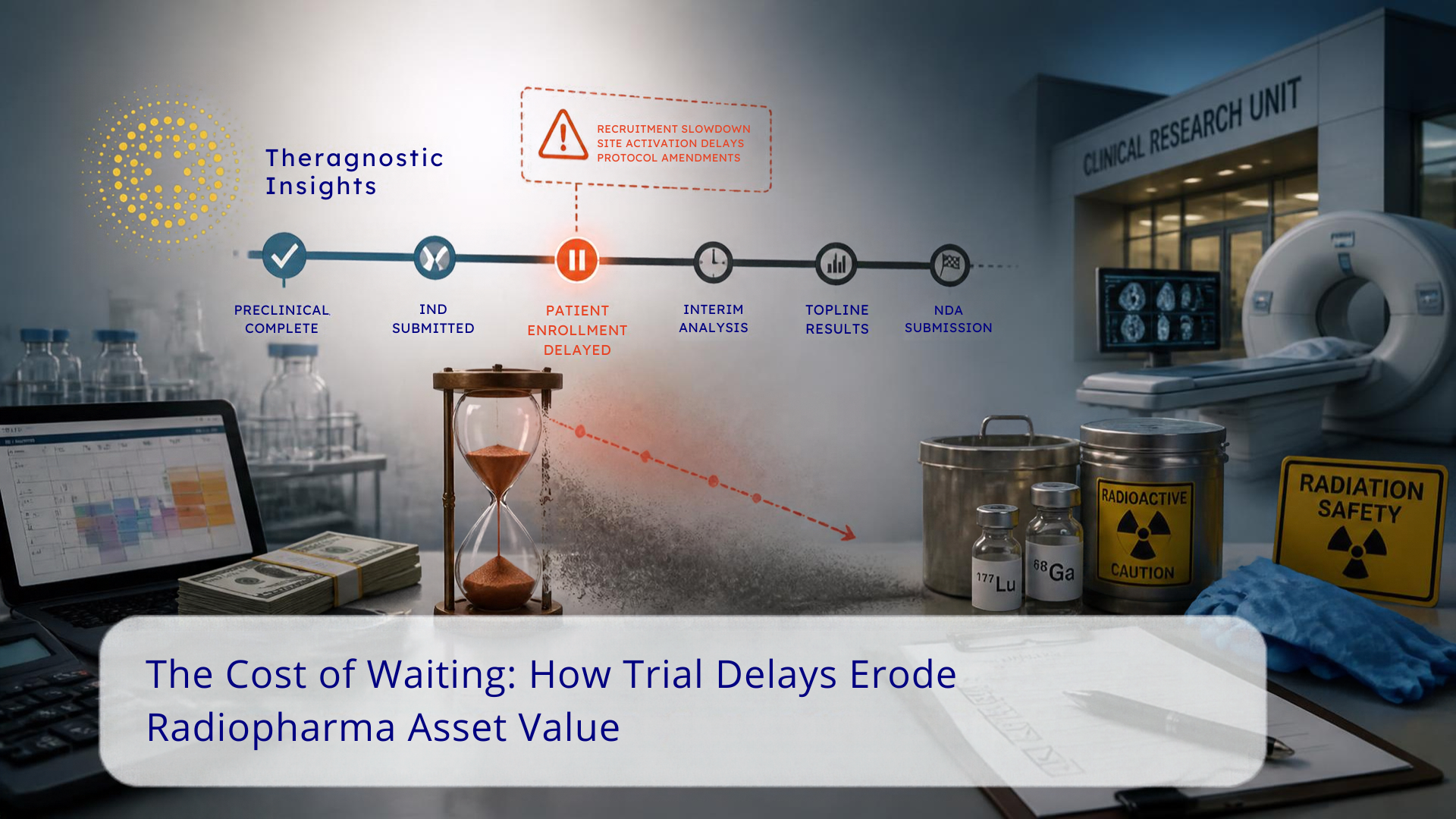
A three-month clinical delay may look like an operational problem on a project plan. For a biotech company, it can mean three additional months of cash burn, a later data readout, a delayed financing milestone, and more time before an asset can reach a partnership or regulatory inflection point.
In radiopharmaceutical development, those pressures intersect with an unusually complex clinical environment. Sites require specialized capabilities. Radioactive materials introduce regulatory and logistical requirements. Protocols must integrate nuclear medicine, imaging, radiation safety, and clinical operations.
When that infrastructure is not ready, time begins to accumulate—and the consequences can extend well beyond the trial timeline.
Clinical Progress Is Part of the Value Story
Biotech valuation is inherently forward-looking. Investors and potential partners assess an asset based partly on what it could become and the probability that it will reach meaningful clinical, regulatory, and commercial milestones.
Clinical progress helps reduce that uncertainty.
Each successful milestone—first patient dosed, dose escalation completed, enrollment completed, meaningful data generated—can provide new evidence about an asset's development potential. Delays postpone those opportunities.
This is particularly relevant in radiopharmaceuticals, where the scientific landscape continues to expand. Zhang et al. describe development across established targets such as PSMA and SSTR as well as emerging programs involving FAP and other targets, with multiple radionuclides and targeting approaches under clinical and preclinical investigation.[1]
More innovation means more potential assets competing for capital, partners, experienced sites, and clinical attention.
In that environment, development speed matters.
A Delay Rarely Stays in One Place
Clinical timelines are interconnected.
A site activation delay can postpone first patient in. Slow enrollment can push back database lock. A later data readout may shift an anticipated financing or partnering window. Additional operating months consume capital that could otherwise support the next study, indication, or development milestone.
For smaller biotech companies, that compounding effect can be especially consequential.
Theragnostic Insights' brand framework identifies time-sensitive development goals, pressure to demonstrate clinical value to investors, and the need to accelerate time to market as core concerns for biotech and pharma teams. For investors, unclear radiopharmaceutical development timelines and the need to accelerate return on investment are similarly important considerations.
This is why biotech valuation and clinical trial delays should not be treated as separate conversations. Operational execution influences when evidence becomes available, and evidence influences how an asset can be evaluated.
Theragnostic Insight: Every avoidable delay has two costs: the direct cost of additional development time and the opportunity cost of postponing the next value-generating milestone.
Radiopharma Adds Another Layer of Execution Risk
Radiopharmaceutical programs face development constraints that conventional oncology experience alone may not fully anticipate.
Radionuclides differ in half-life, decay mode, radiation energy, production method, and clinical application.[1] Those characteristics can shape manufacturing, distribution, imaging, patient scheduling, dosimetry, and site requirements.
Clinical sites may also need specialized personnel, infrastructure, radioactive-material capabilities, and integrated workflows. Theragnostic Insights identifies limited understanding of site capabilities, unique radioactive-material regulations, and the challenge of balancing scientific rigor with practical protocol implementation as recurring development pain points.
A program can therefore have compelling biology and sufficient funding while still losing time because operational assumptions were made too late.
The practical implication for radiopharma asset valuation is important: scientific quality and execution readiness are connected.
Protecting Value Starts Before the Trial Slows
The strongest response to delay is prevention.
Before study launch, sponsors can pressure-test whether the protocol is executable at the sites expected to enroll it. Site feasibility can evaluate actual nuclear medicine capacity rather than institutional reputation alone. Supply-chain assumptions can be tested against isotope characteristics and patient scheduling. Roles across clinical operations, radiopharmacy, imaging, and radiation safety can be clarified before activation.
Development teams can also identify the milestones most important to financing, partnering, or portfolio decisions and work backward from them.
That does not eliminate uncertainty. Clinical development will always encounter factors that cannot be predicted.
It does, however, distinguish unavoidable scientific uncertainty from preventable operational friction.
For investors and potential partners, the same thinking can strengthen diligence. The question is not simply whether the science is compelling. It is whether the organization has a credible clinical development strategy capable of generating the evidence required to support the next stage of value creation.
What This Means for You
Radiopharmaceutical companies are competing on science, targets, isotopes, manufacturing, and intellectual property. Increasingly, they are also competing on execution.
A program that reaches meaningful clinical evidence efficiently can preserve capital, strengthen strategic optionality, and give investors and partners clearer information on which to base decisions. A program that repeatedly loses time to foreseeable operational barriers may erode those advantages before the science has a chance to demonstrate its value.
Theragnostic Insights helps teams identify these risks early by connecting scientific strategy with clinical reality—site capabilities, protocol design, operational readiness, and development decision-making. That directly supports the company's purpose of accelerating radiotherapies from concept to clinic.
In radiopharma, protecting the timeline is part of protecting the asset.
References
[1] Zhang S, Wang X, Gao X, et al., 2025. Radiopharmaceuticals and their applications in medicine. Signal Transduction and Targeted Therapy, 10:1.
[2] Theragnostic Insights, 2025. Brand Guidelines V1. Clinical development positioning and stakeholder framework.
