The Hidden Economics of Radiopharmaceutical Trials
The Hidden Economics of Radiopharmaceutical Trials
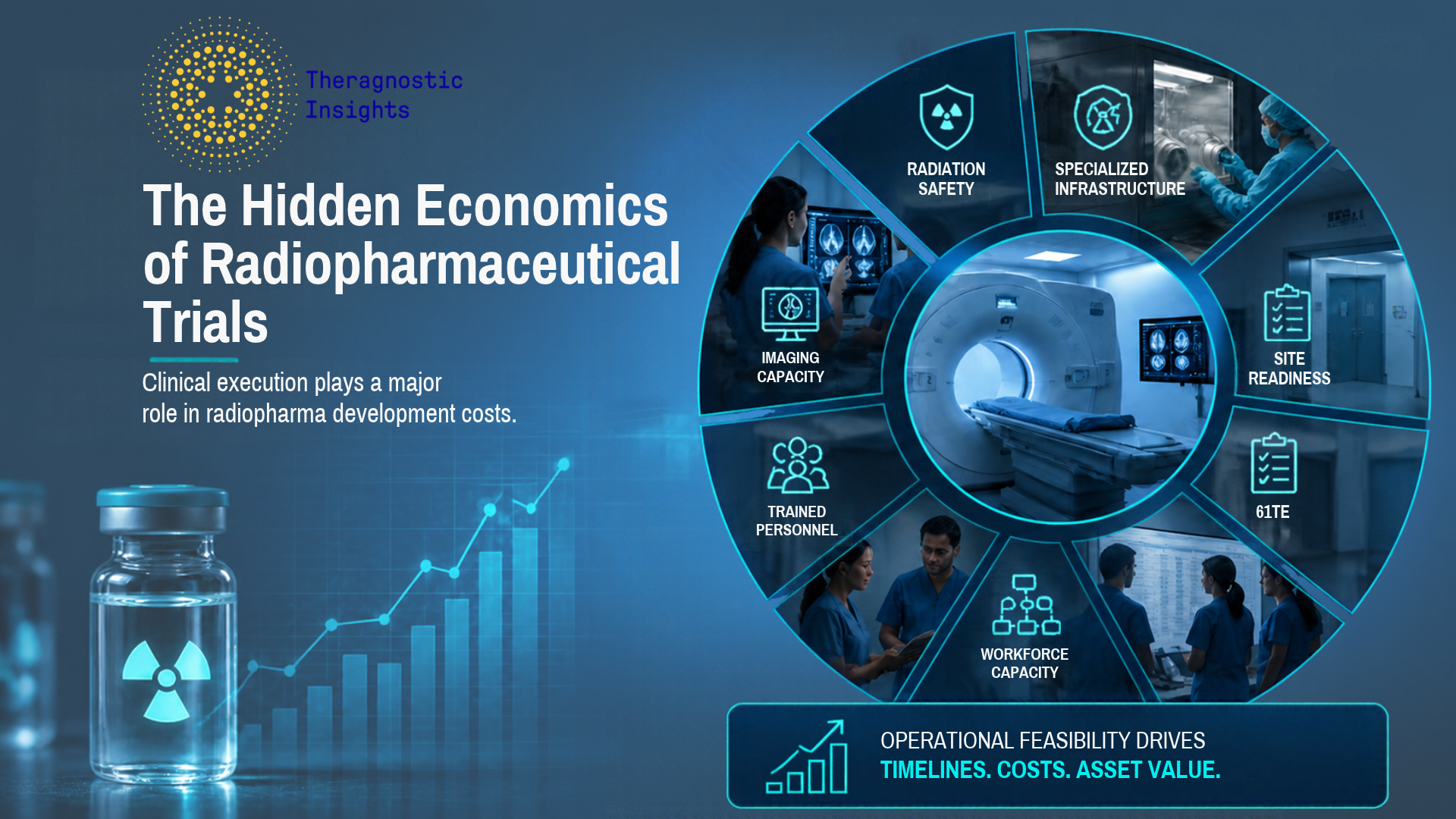
The cost of radiopharma development isn’t just drug manufacturing. Clinical execution plays a major role.
Investment in radiopharmaceuticals continues to expand, with considerable attention directed toward isotope production, manufacturing capacity, and pipeline development. These investments address important challenges in bringing new therapies to market.
But the economics of radiopharmaceutical development extend well beyond producing the investigational product.
Every clinical trial requires a specialized network of facilities, personnel, equipment, and operational workflows. When these requirements are underestimated, development costs can increase through delayed activation, inefficient enrollment, additional site support, and extended trial timelines.
For sponsors and investors, understanding the full economics of clinical execution is becoming increasingly important.
The Cost Structure Is Different
Traditional oncology trials already require significant investment in clinical operations, monitoring, data management, and patient care.
Radiopharmaceutical trials introduce additional requirements.
Depending on the investigational product and protocol, sites may need specialized radioactive-material handling, radiopharmacy capabilities, nuclear medicine physicians, trained technologists, radiation safety oversight, imaging infrastructure, and dosimetry expertise.
Radionuclide selection also influences operational planning. Zhang et al. describe substantial differences in half-life, radiation emissions, and biological applications across diagnostic and therapeutic radionuclides.[1]
These characteristics affect manufacturing, transportation, administration, radiation protection, and clinical workflows.
As a result, radiopharma trial costs are influenced by the interaction between the investigational product and the clinical infrastructure required to deliver it.
Infrastructure Has an Economic Footprint
A qualified radiopharmaceutical trial site represents years of institutional investment.
Licensing, shielding, imaging equipment, radioactive-material storage, waste management, and specialized personnel all contribute to operational readiness. Requirements vary by radionuclide, administered activity, and applicable regulations.[2]
Yet infrastructure availability does not necessarily translate into available trial capacity.
A site may possess the required equipment but lack sufficient personnel or scheduling flexibility to support another investigational program. Competing clinical responsibilities and research commitments can further limit availability.
For sponsors, these constraints may create additional costs through prolonged feasibility assessments, delayed site activation, increased coordination, or the need to qualify alternative locations.
The economic consequence is straightforward: infrastructure limitations can affect both the direct cost of trial execution and the time required to generate clinical evidence.
Theragnostic Insight: Site readiness is an economic variable. Evaluating actual clinical capacity before protocol activation can help sponsors distinguish manageable operational requirements from constraints likely to affect development timelines.
Operational Complexity Creates Hidden Costs
Radiopharmaceutical trials depend on tightly coordinated activities across manufacturing, distribution, site operations, and patient care.
The operational sequence may include isotope production, radiolabeling, quality release, transportation, site receipt, patient preparation, administration, imaging, and radiation safety procedures.
Each step introduces dependencies.
A scheduling disruption may affect product usability, particularly when short-lived radionuclides are involved. Patient cancellations can create additional coordination requirements. Imaging and dosimetry procedures may increase the number of visits, specialized staff hours, and data-management activities required by the protocol.
These are practical examples of RLT operational complexity translating into development economics.
The financial impact depends on the product, protocol, site network, and supply model. However, treating these activities as routine clinical logistics can lead to incomplete budgets and unrealistic timelines.
Clinical Capacity Influences Capital Efficiency
The economic implications become more significant when operational constraints affect the development schedule.
Delayed enrollment can extend site-management costs, clinical operations expenses, and organizational cash burn. Later data readouts may also postpone financing, partnering, and portfolio decisions.
For emerging biotech companies, these delays can reduce financial flexibility.
For larger pharmaceutical organizations, they can affect resource allocation across competing development programs.
Investors evaluating radiopharmaceutical assets should therefore consider whether clinical execution assumptions are sufficiently developed to support the proposed timeline.
A manufacturing strategy may demonstrate that a product can be supplied. A clinical development strategy must demonstrate that qualified sites can administer it, collect the required evidence, and sustain enrollment.
Both influence the capital required to advance an asset.
Building Operational Economics Into Development Strategy
The opportunity is to incorporate radiopharmaceutical trial infrastructure into development planning before major operational commitments are made.
Sponsors can strengthen budgets and timelines by evaluating site capabilities, staffing availability, radionuclide logistics, imaging requirements, and protocol complexity together.
Early coordination among clinical development, manufacturing, radiopharmacy, nuclear medicine, and radiation safety teams can identify assumptions that might otherwise surface during activation or enrollment.
For community-site expansion, this assessment is particularly important. New sites may improve patient access and geographic reach, but readiness investments should be matched to realistic enrollment potential and long-term clinical capacity.
The objective is disciplined allocation of resources across the full development pathway.
What This Means for You
Radiopharmaceutical development economics are shaped by more than isotope availability, manufacturing costs, and scientific innovation.
Clinical execution determines how efficiently those investments can generate meaningful evidence.
For biotech and pharma, understanding operational costs supports more realistic budgets and development timelines. For healthcare systems, it informs infrastructure and workforce investment. For investors, it provides a clearer assessment of execution risk and capital requirements.
Theragnostic Insights helps organizations connect scientific strategy with practical clinical implementation, bringing site readiness, protocol feasibility, operational coordination, and development economics into the same conversation.
The next phase of radiopharmaceutical growth will depend on how effectively the industry invests across the entire development pathway—from manufacturing through clinical execution.
Mini-Series: Clinical Capacity Crisis
The Hidden Economics of Radiopharmaceutical Trials is part of our Clinical Capacity Crisis: The Hidden Bottleneck in Radiopharma Development series, exploring how workforce, infrastructure, site capacity, and operational constraints influence the economics and execution of radiopharmaceutical development.
References
[1] Zhang S, et al., 2025. Radiopharmaceuticals and their applications in medicine. Signal Transduction and Targeted Therapy. Nature
[2] U.S. Nuclear Regulatory Commission. 10 CFR Part 35: Medical Use of Byproduct Material. Regulatory requirements for medical radioactive-material use. NRC
[3] U.S. Food and Drug Administration. Current Good Manufacturing Practice for Positron Emission Tomography Drugs. 21 CFR Part 212. eCFR
[4] International Atomic Energy Agency. Nuclear Medicine Resources. Guidance on nuclear medicine infrastructure, radiation safety, and clinical implementation. IAEA
